From Lecture Recording to Exam-Ready Notes: The Pipeline I Actually Use
A six-course case study of turning lecture audio, transcripts, PDFs, and professor signals into source-locked study documents and NotebookLM decks.
The two-minute version
A transcript is not a study guide. It is a noisy evidence layer.
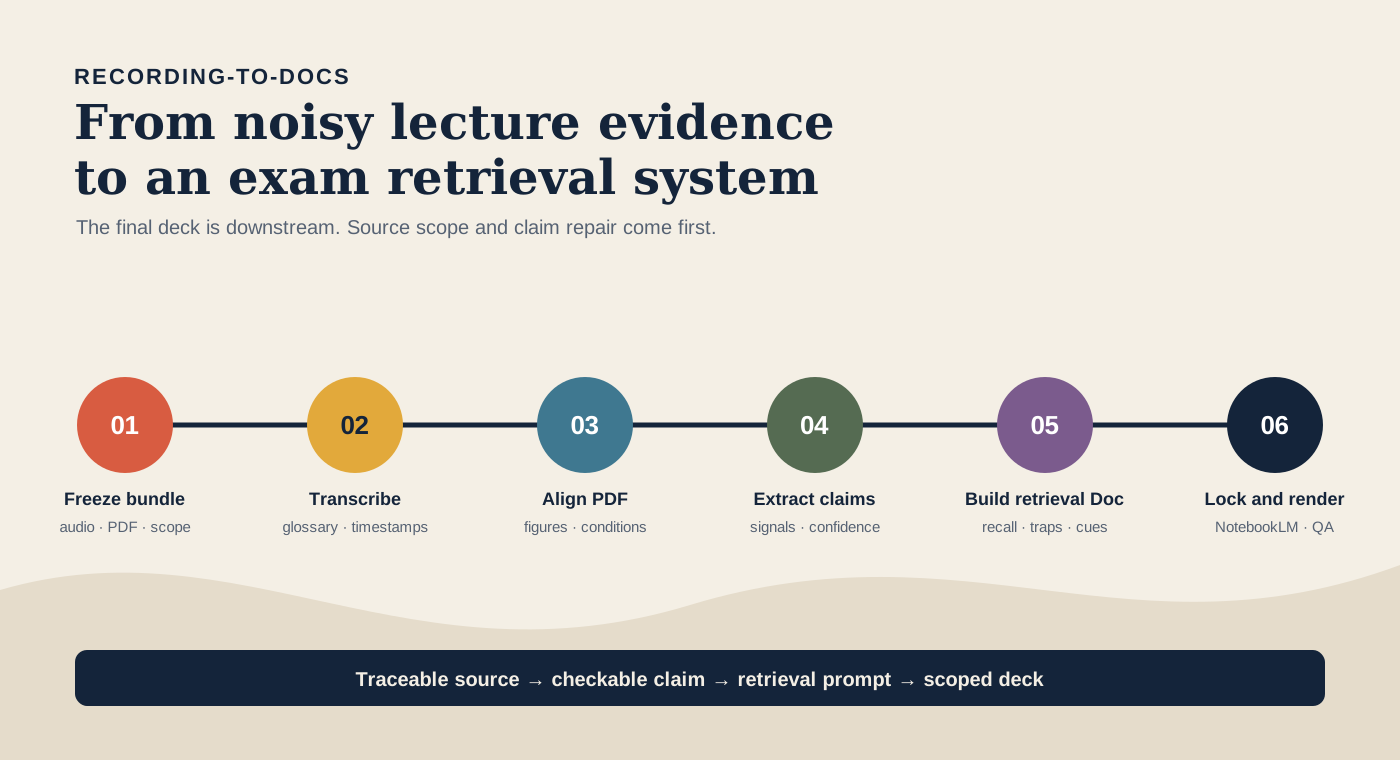
The pipeline I use now starts by freezing the lecture bundle: recording or transcript, lecture PDF, supporting notes, and the exact date or chapter range. It then repairs terminology with a small glossary, aligns spoken explanations with pages and figures, extracts claims and exam signals, and builds a document for recall rather than passive reading. NotebookLM comes after that work, not before it.
I arrived at this structure during a six-course finals cycle. The recorded snapshot contains 24 reassembled study documents and 103 NotebookLM sources marked ready across the six course notebooks. Those counts show that the source packaging ran; they do not prove higher grades, perfect transcripts, or complete syllabus coverage.
The most important change was simple: I stopped asking, "How do I summarize this lecture?" and started asking, "What must I be able to retrieve, apply, and check under exam conditions?"
Tested with
| Field | Recorded scope |
|---|---|
| Course notebooks | 6 |
| Reassembled study documents | 24 |
| NotebookLM source readiness at snapshot | 103 of 103 ready |
| Source types | Lecture transcripts, lecture PDFs, existing study documents, and selected supporting material |
| Output path | Structured study Docs, source-locked NotebookLM bundles, and deck briefs |
| Snapshot date | 2026-06-11 |
What this is based on
This is an operational case study, not a controlled learning experiment. It is based on the private run records created while I rebuilt six engineering-course study sets for finals. The public anonymized case manifest preserves the document and source counts without exposing course names, lecture text, Google Drive IDs, or private links.
One bundle was explicitly recorded as provisional because a later lecture PDF and recording had not yet been incorporated. That caveat matters: ready meant that NotebookLM had ingested the selected source set. It did not mean that every future lecture or every page in the course had already been covered.
Sources: the anonymized run manifest, the copyable lecture bundle manifest, and the exam retrieval document template.
The summary-first version failed in a predictable way
My earlier documents were readable. They opened with a quick checklist, pulled professor comments forward, explained the main concepts, and ended with likely questions. That was already better than a raw transcript.
It still asked the reader to do too much work.
A long, tidy lecture summary makes sense while you are reading it. A week before an exam, that is not enough. You need to know what deserves attention first, which formula only works under a particular condition, what the professor returned to repeatedly, where the evidence is weak, and how the idea might be turned into a problem.
The old structure also overloaded one importance marker. A high rating could mean "the professor emphasized this," "this appears central in the PDF," "this is likely to be tested," or merely "this seems important." Those are not the same claim. When they are collapsed into one star rating, everything drifts toward the middle and the mark stops helping.
So I changed the unit of work. The pipeline no longer begins with prose. It begins with a source bundle and a ledger of checkable claims.
The pipeline, step by step
1. Freeze the lecture bundle before generating anything
A lecture file name is not a scope definition. Before transcription or writing, I create a small manifest that records:
- the lecture date or chapter range,
- the recording, transcript, and PDF files in scope,
- supporting notes or past problems that are allowed,
- files that are deliberately excluded,
- source timestamps or modification dates,
- known coverage gaps,
- the proposed output bundle.
This prevents a quiet but common failure: the generated document looks coherent while drawing from the wrong lecture, an outdated note, or a PDF range that extends beyond the transcript.
The manifest also makes later corrections possible. If a formula is wrong in the final document, I can trace which transcript and PDF produced it instead of trying to reconstruct the job from chat history.
2. Build a terminology glossary before cleaning the transcript
Technical speech recognition often fails on the terms that matter most: acronyms, variable names, component names, English terms spoken inside Korean sentences, and words that differ by one syllable.
I do not ask an LLM to "fix the transcript" without constraints. First I pull a compact glossary from:
- PDF headings and figure labels,
- formula variables and units,
- table headings,
- syllabus terms,
- repeated vocabulary in nearby lectures,
- textbook chapter names when they are part of the assigned material.
That glossary can bias the speech-to-text pass when the backend supports a prompt, and it becomes the correction vocabulary afterward. The point is consistency. A term should not be repaired one way in the transcript, another way in the study Doc, and a third way in the NotebookLM deck.
When the evidence is weak, the transcript keeps an uncertainty marker. A polished guess is more dangerous than an ugly but visible uncertainty.
3. Preserve timestamps and the raw transcript
The cleaned transcript is a working document. The raw transcript is evidence and stays untouched.
For audio-first jobs, I keep a readable transcript with timestamps so an important claim can be traced back to the recording. Timestamps are especially useful when:
- the professor repeats a warning,
- a formula name is unclear,
- a student question changes the interpretation,
- the spoken explanation departs from the slide,
- the transcript loses a negative word or condition.
The timestamped version is not there for decoration. It gives the repair pass somewhere to go when the PDF alone cannot settle the wording.
4. Align the transcript with the PDF visually
Text extraction is not enough for engineering material. A professor may say "this curve," "the left case," or "when this switch opens" while the meaning lives in a graph, circuit, table, or handwritten annotation.
I compare the spoken order with the actual page sequence and attach page, figure, equation, or table cues where possible. The check asks:
- What visual object was being discussed?
- Did the professor follow the slide or jump elsewhere?
- Which condition or label is visible but absent from the transcript?
- Did the professor add an interpretation that the PDF does not state?
- Is handwriting clear enough to use, or should it remain uncertain?
This is one of the points where manual inspection still earns its time. OCR can find text. It cannot reliably decide which part of a crowded circuit diagram the professor meant by "here."
5. Extract claim atoms before writing sections
A claim atom is one statement that can be checked and studied independently. Instead of immediately producing a chapter summary, I extract units such as:
- a definition,
- a formula and its valid conditions,
- a cause-and-effect relationship,
- a worked-example decision,
- a professor warning,
- a likely problem variation,
- a common error,
- an unresolved conflict.
Each important atom receives an evidence cue. That might be a transcript timestamp, PDF page, figure, equation, or supporting document.
This sounds bureaucratic until the first contradiction appears. If the transcript says one thing and the PDF formula says another, a claim ledger exposes the conflict before it is buried inside fluent prose.
6. Separate importance from confidence
Importance answers: "How costly would it be to ignore this?"
Confidence answers: "How strong is the evidence for this wording and interpretation?"
A point can be high importance and low confidence. That combination should become more visible, not disappear. It tells me to check the source before memorizing it.
In the student-facing document, I avoid internal labels such as claim atom or problemability. The rendered language is shorter:
| Internal decision | Student-facing label |
|---|---|
| Importance | How much should I care? |
| Confidence | How sure is this? |
| Evidence anchor | Where did this come from? |
| Problem variation | How could this appear? |
| Error condition | What will make me lose points? |
This translation matters. The analysis can be technical; the document used during a cram session cannot feel like an audit database.
7. Build an exam retrieval document, not a transcript rewrite
The final document is ordered by retrieval value.
It starts with a dashboard that can be scanned quickly:
- highest-yield concepts and problem types,
- direct or strong professor signals,
- formulas with conditions,
- examples safest to practice,
- common loss-of-points traps,
- important items that still need source checking.
Each major item then follows a compact pattern:
What to remember
Why it matters
How it can appear
What people get wrong
Source cue
Ask yourself
The longer reconstruction of the lecture remains available, but it moves lower in the document. It provides context without blocking the five-minute review path.
8. Convert high-value claims into retrieval prompts
A five-star bullet that the student only rereads is still passive material. High-value claims need an action:
- explain why a formula is invalid under a changed condition,
- choose between two models and justify the choice,
- detect the error in a worked solution,
- redraw the figure from memory,
- predict what changes when one parameter moves,
- solve the same pattern with a new given value.
The question should resemble the mental move required on the exam. "Define X" is useful for a definition. It is weak preparation for a problem where the student must recognize when X applies.
9. Lock the NotebookLM source set before making a deck
NotebookLM is downstream in this workflow. I do not select every file in a course notebook and hope the model respects the intended lecture range.
For each deck, I clear the source selection and enable only:
- the corrected study document,
- the matching PDF or page range,
- a separate deck brief when needed,
- relevant past problems or solutions that belong to the same scope.
The six-course run eventually used 24 reassembled documents because the original date-based material did not always match the chapter or problem boundaries needed by a deck. Splitting by source scope reduced the chance that one lecture's terminology, example, or formula would leak into another deck.
A deck brief then states the bundle token, allowed and excluded sources, formula ledger, likely problem patterns, professor traps, visual evidence plan, and whether the material should remain one deck or be split.
10. Route failures back to the layer that owns them
A bad slide is not always a prompt problem.
| Failure | Repair layer |
|---|---|
| Wrong or stale source selected | Source manifest and source lock |
| Formula or factual error | Transcript/PDF reconciliation and corrected Doc |
| Important professor trap absent | Claim extraction and deck brief |
| Deck is too dense | Bundle split or length decision |
| Layout or wording is awkward | Renderer prompt or slide revision |
| Another lecture appears in the deck | Source selection and bundle isolation |
This avoids the common response of making one giant prompt longer every time something goes wrong. If the source is wrong, prompt engineering cannot make the result trustworthy.
A small example of the transformation
The example below is composite and anonymized. It demonstrates the structure; it is not a quotation from a private lecture.
Suppose a transcript says:
Students often plug this value into the formula immediately. Check the assumption first. If the condition is not satisfied, the result looks neat but is wrong.
The PDF shows the formula and its condition on page 18. A summary-first document might produce: "Use Formula A to calculate the response."
The retrieval document instead records:
| Field | Output |
|---|---|
| What to remember | Formula A is valid only when Condition B holds. |
| Why it matters | The professor warned against substituting values before checking the assumption. |
| How it can appear | A problem may give values that make Condition B fail and ask whether Formula A is valid. |
| What people get wrong | They calculate first and never test the condition. |
| Source cue | Transcript timestamp + PDF p.18 formula condition |
| Ask yourself | What evidence in the given values proves that Formula A can be used? |
The second version is longer than one summary sentence but faster to study because every line has a job.
What the six-course run taught me
Source readiness is not syllabus completeness
The snapshot showed 103 of 103 selected NotebookLM sources ready. That verified ingestion state. It did not prove that every future lecture had been added. One bundle was intentionally labeled provisional until later material could be incorporated.
That distinction prevents a green status light from being mistaken for academic completeness.
One notebook can still require many small source bundles
The six course notebooks did not become six giant decks. They became 24 reassembled study documents because useful study scope often follows chapters, problem families, or formula dependencies rather than calendar dates.
A clean document can still be the wrong document
Formatting checks are necessary but weak. I also check the title, first substantive section, a later section, source scope, Korean/English text integrity, and whether important markers survived the Google Docs insertion. File existence alone does not prove that the correct body was uploaded.
The final interface should hide most of the machinery
The internal workflow uses manifests, evidence ledgers, confidence calibration, and failure routing. The student should mainly see:
- what to learn,
- why it matters,
- how it may be tested,
- where the trap is,
- where the claim came from.
Complexity belongs in the pipeline when it makes the final document simpler.
What I automate and what I still inspect
| Stage | Good automation target | Human review still needed |
|---|---|---|
| Source inventory | File listing, dates, IDs, hashes, manifest draft | Correct lecture and chapter scope |
| Speech-to-text | Transcription, timestamps, glossary bias | Unclear technical terms and lost conditions |
| PDF alignment | Candidate page and keyword matches | Figures, circuits, graphs, and handwriting |
| Claim extraction | Candidate claims, repeated warnings, formula rows | Importance, interpretation, and conflicts |
| Document rendering | Tables, headings, dashboards, links | Readability and whether the exam logic is useful |
| NotebookLM setup | Source listing, add/sync checks, readiness state | Exact source selection and leakage review |
| Deck QA | Coverage counts and formula-condition checks | Whether the slides support real problem solving |
The goal is not full automation. It is to spend human attention on ambiguity and decisions instead of file shuffling and formatting.
Copy the lecture bundle manifest
Download the CSV template, or copy this compact version:
bundle_token:
course_alias:
lecture_dates:
chapter_or_problem_scope:

allowed_sources:
- transcript:
- lecture_pdf:
- corrected_study_doc:
- supporting_problem_set:

excluded_sources:
- <add excluded source>

source_snapshot:
- filename:
  role:
  modified_at:
  source_id_or_path:

coverage_gaps:
- <add coverage gap>

uncertain_terms_or_conflicts:
- <add uncertain term or conflict>

output_plan:
- study_doc_name:
- notebook_name:
- deck_length_or_split:

verification:
- transcript_timestamp_check:
- pdf_visual_check:
- doc_body_readback:
- notebook_source_lock:
- prompt_readback:
- post_generation_source_check:
A more detailed exam retrieval document template is available as Markdown. It is designed to be copied into Google Docs, Obsidian, or another editor rather than requiring my exact tool stack.
Limits
This case study has several boundaries:
- It records one finals-cycle workflow, not a randomized comparison with ordinary note-taking.
- The source-readiness counts measure selected NotebookLM sources, not learning gains or grades.
- The raw transcripts, private lecture materials, Drive IDs, and original study documents are not public.
- Technical courses with formulas and diagrams benefit more from visual PDF alignment than text-only subjects may.
- Professor-signal inference can be wrong. Indirect signals remain labeled as inference rather than direct statements.
- Speech recognition quality depends on the recording, language mix, terminology, and hardware.
- A source-locked system can still preserve an error that already exists in the assigned material. It improves traceability; it does not create an independent authority.
Continue the series
If you want the claim-checking layer in isolation, read Build a Source-to-Claim Map Before You Summarize a PDF.
For the final audit pass, use How to Audit an AI-Generated Study Guide Against the Source.
The next part of this series will cover the memory layer: how I separate compact agent memory, an Obsidian knowledge vault, session history, and working Google Docs instead of forcing every kind of knowledge into one system.
Bottom line
The useful product is not the transcript, the summary, or the slide deck. It is the chain that lets a student move from a noisy recording to a claim they can retrieve, apply, and trace back to the source.
My working order is:
freeze the bundle
→ transcribe without destroying the raw evidence
→ align speech with the PDF
→ extract claims and exam signals
→ separate importance from confidence
→ build the retrieval document
→ lock the NotebookLM source set
→ generate and audit the deck
That order is slower than pressing "summarize" once. It is faster than discovering, two days before an exam, that a clean set of notes taught you the wrong condition.